Fairness evaluation for any classification or segmentation model
FairMedFM measures how a model's performance differs across groups such as sex, age, hospital or scanner. Give it your model's predictions and the group of each sample; it reports subgroup AUC, accuracy and calibration gaps, equal opportunity, equalized odds, and Dice disparities. It is also the FairMedFM benchmark of 20 medical imaging foundation models on 17 datasets.
# pip install fairmedfm
import fairmedfm as fm

fm.auc_gap(y_true, y_score, sensitive_features=group)      # one number, like sklearn.metrics
report = fm.evaluate(y_true, y_score, sensitive_features=df[["sex", "age"]], bins={"age": [40, 60]})
-
Any model, any domain
Binary classifiers and segmentation models from any framework. Pass labels, probabilities, logits or masks as you have them; FairMedFM does not need to run your model.
-
Fits your workflow
sklearn-style functions for training loops and model selection, pandas reports, or a command line for prediction files. Needs only NumPy, pandas and scikit-learn.
-
Same numbers as the paper
The metrics are checked against the implementation behind the FairMedFM paper, in continuous integration.
-
Full benchmark included
The benchmark runner, installed from GitHub, adds
fairmedfm run: linear probing, CLIP zero-shot and adaptation, and promptable segmentation with SAM-family models. See Installation.
What it measures
| Task | Metrics |
|---|---|
| Binary classification | Overall AUC, accuracy, BCE and ECE; worst-group AUC; AUC, accuracy, BCE and ECE gaps between groups; equal opportunity (TPR gap) and equalized odds |
| Segmentation | Mean Dice; worst and best group Dice and their gap; standard deviation and skewness across groups; equity-scaled Dice |
See Fairness metrics for exact definitions.
Two ways to use FairMedFM
Evaluate your own model. Run your model anywhere, then call a metric such as fm.auc_gap or the full
fm.evaluate on its outputs, use them as scikit-learn scorers, or point fairmedfm score at prediction files. See
Evaluate your model.
Run the benchmark. Evaluate built-in foundation models such as CLIP, BiomedCLIP, MedCLIP, DINOv2, SigLIP,
RETFound, SAM and MedSAM on medical imaging datasets with fairmedfm run. See Run experiments.
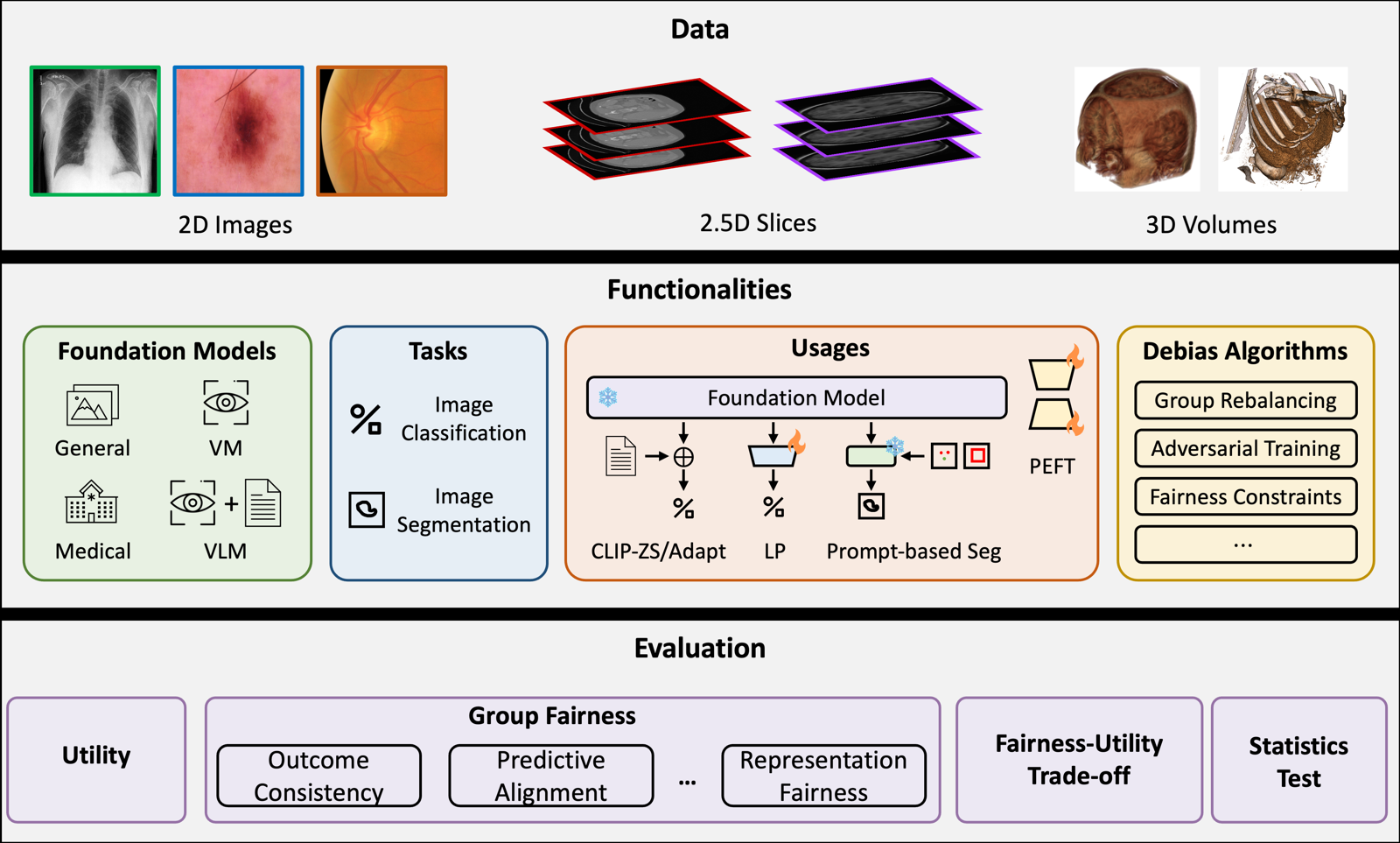
Key findings from the FairMedFM benchmark
- Bias is pervasive: all evaluated medical foundation models show fairness disparities across sex, race and age.
- Utility and fairness trade off differently: the most accurate model is often not the fairest.
- The dataset matters most: disparities on a dataset stay similar regardless of the foundation model.
- Mitigation has limited effect: existing unfairness mitigation methods give only marginal improvements.
Read the paper: FairMedFM: Fairness Benchmarking for Medical Imaging Foundation Models. For capability (rather than fairness) evaluation of medical vision-language models, see the companion benchmark MedVLMBench.